The last time I called my youngest daughter before Christmas, she answered on the fourth ring and sighed before saying hello.
I knew that sigh. It was the sound people make when they have already decided you are asking for something before you have spoken a word.
“Hi, sweetheart,” I said. “I was just checking whether you and the kids are coming over for Christmas.”
“Mom, we already talked about this.”
“I know. I just wanted to make sure.”
“You call too much.”
I stopped walking through the kitchen.
There was a saucepan cooling beside the stove, a half-folded dish towel on the counter, and the faint smell of cinnamon from the cookies I had baked that morning. Everything around me was ordinary. Her voice made the room feel suddenly unfamiliar.
“I call once or twice a week,” I said quietly.
“That’s a lot when you have work, children, a husband, and your own life.”
I waited for her to soften the words.
She didn’t.
Then my son Brandon joined the conversation through speakerphone. I could hear traffic behind him.
“Mom, Jessica’s right,” he said. “We’re not teenagers anymore. We have our own families.”
“I never said you didn’t.”
“You keep checking where we are, what we’re doing, whether we’re coming over. It’s exhausting.”
The third voice was Jessica’s.
“Please stop calling us so much. If something is wrong, we’ll call you.”
That sentence stayed with me long after the conversation ended.
I had spent thirty years being the person they called when someone had a fever, needed money for college, had a broken-down car, needed a babysitter, or simply wanted to hear that everything would eventually be all right.
Apparently, somewhere along the way, my concern had become an inconvenience.
So I made a decision.
I would stop calling.
Not to punish them.
Not to make them feel guilty.
I simply wanted to know what happened when I stopped reaching first.
The first week was difficult.
My hand kept reaching for my phone whenever I finished dinner. I would see something funny online and think of Chloe. I would hear a song Robert used to sing badly around the house and think of Brandon. When I passed a bakery selling the cinnamon rolls Jessica loved as a child, I nearly called her.
Each time, I put the phone back down.
By the second week, the silence became easier.
By the fourth, it had become part of my routine.
I watered the roses in the morning, took longer walks around the neighborhood, read before bed, and began having coffee with two women from the garden club on Thursdays.
Nobody from my family called.
Christmas approached.
I bought presents for the grandchildren anyway.
I wrapped each one carefully and placed them beneath the tree, even though I had no idea whether I would see them.
The house was large enough to feel ridiculous with only one person living in it.
Robert had loved the place.
He had chosen the property nearly twenty years earlier, back when our children were still young enough to race through the hallways in socks.
After he died, I had thought about selling.
But I couldn't bring myself to do it.
There were pencil marks inside the pantry door showing how tall the children had been at different ages. There was a dent in the staircase where Brandon had once dragged a bicycle upstairs. The upstairs hallway still carried the faint smell of old cedar from the cabinet Robert had built himself.
It wasn't just a house.
It was the container for nearly every version of my family.
That was why I noticed when conversations about the property had begun changing.
The children no longer asked how I was maintaining the house.
They asked what I planned to do with it.
Would I ever move?
Had I considered something smaller?
Was the property really worth what the realtor down the street claimed?
Did Robert leave everything in a trust?
At first, I dismissed the questions.
Then they became more frequent.
I remembered one conversation with Brandon several months before the silence began.
He had been standing near the living-room window, staring toward the backyard.
“You know, Mom, this place is probably worth a fortune now.”
“I suppose it is.”
“You ever think about selling?”
“Sometimes.”
“You could make your life much easier.”
I smiled. “I'm doing all right.”
He looked disappointed.
I hadn't understood why at the time.
Now I wondered.
The day before Christmas Eve, I checked my phone before breakfast.
Nothing.
No messages.
No missed calls.
Not even a photograph from one of the grandchildren.
I felt the old ache in my chest, but I didn't pick up the phone.
Instead, I made coffee.
That afternoon, a neighbor dropped off a small loaf of homemade bread. We stood at the front door talking for nearly twenty minutes. She asked about my children.
“They're busy,” I said.
She gave me a sympathetic smile.
I didn't correct her.
Christmas morning arrived cold and bright.
I was halfway through breakfast when I heard tires on the gravel outside.
At first, I assumed it was a delivery.
Then I heard another vehicle.
And another.
I set down my coffee.
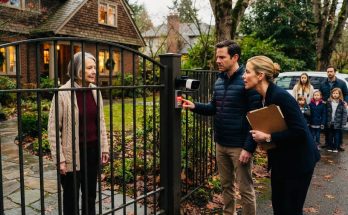
Through the window, three SUVs were lined along the driveway.
My heart began beating faster.
Brandon stepped out first.
Jessica followed.
Chloe was behind them, and with them came their spouses and several grandchildren bundled in winter coats.
For one foolish second, relief washed through me.
They had come.
They had finally remembered me.
Then I noticed the folder Jessica was carrying.
It was thick.
Too thick for Christmas cards.
Brandon walked directly toward the gate.
He entered the code.
The keypad flashed red.
He tried again.
Red.
His smile disappeared.
He stared at the keypad as if the machine had personally betrayed him.
I had changed the access code two weeks earlier.
He hadn't been told.
Jessica stepped toward the security camera mounted above the gate.
“Mom?” she called.
I pressed the intercom.
“What are you doing here?”
“It’s Christmas.”
“I know.”
“The kids want to see you.”
I looked through the window at my grandchildren.
I loved them.
That was precisely what made the situation difficult.
“Why didn’t you call first?”
Jessica glanced toward Brandon.
“We thought we’d surprise you.”
I looked at the folder again.
Something about the way she held it bothered me.
“What’s in the folder?”
“Just some paperwork.”
“What kind?”
“Nothing serious.”
I felt the warmth drain from my face.
Nothing serious was not an answer.
Brandon stepped closer to the gate.
“Mom, open up.”
I stayed where I was.
The house was silent behind me.
Outside, my children stood beside the grandchildren I had spent three months missing.
And for the first time, I wondered whether they had come because they missed me—or because they needed something from me.
Click here to continue reading: PART 2: My Children Said They Came for Christmas, Yet Their Questions About My House and the Papers in Jessica’s Hands Made Their Real Purpose Impossible to Ignore
I Thought My Children Were Simply Busy Until Three Silent Months Ended With Three Cars Outside My Gate and a Folder I Wasn’t Supposed to Question
Part 1 of 12