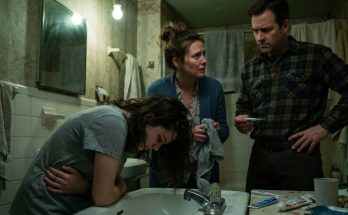
I knew something was wrong before the nurse finished calling my daughter’s name.
She was sitting on the edge of the emergency-room bed with one hand pressed against her side, her knees pulled together, and her face drained of color beneath the harsh fluorescent lights. Ten minutes earlier, she had been crying so hard that she could barely speak. Now she was completely still.
“Sweetheart,” I said, touching her hair, “tell me where it hurts.”
She looked at me.
Not at the nurse. Not at the doctor standing behind the curtain. Me.
Then her eyes moved toward the hallway.
Her lips barely opened.
“He knows why it hurts.”
I frowned. “Who knows?”
She swallowed.
Before she could answer, a nurse stepped into the room carrying a blood-pressure cuff.
“Mrs. Carter, we need to get her vitals again.”
My daughter grabbed my wrist.
Hard.
“Mom.”
Her voice was so quiet I almost missed it.
“Don’t let him come in.”
I looked toward the doorway.
There was no one there.
Yet my daughter kept staring at the empty opening as though she could see someone standing on the other side.
My name is Claire Bennett. I was thirty-eight years old that winter, and until that night, I believed I knew almost everything important about my twelve-year-old daughter, Emily.
I knew she hated tomatoes but loved tomato soup.
I knew she slept with one foot outside the blanket.
I knew she hummed when she was nervous.
I knew she could remember entire conversations after hearing them once.
And I knew that when Emily was frightened, she usually reached for my hand.
That night, she did something different.
She tried to hide.
The emergency department was crowded. Phones rang at the central desk. Rubber wheels squeaked across the polished floor. Somewhere behind the curtain, a monitor beeped at steady intervals while a child cried for his father.
The smell of antiseptic hung in the air.
Emily sat motionless while the nurse wrapped the cuff around her arm.
Her blood pressure was low.
The nurse glanced at the monitor, then at me.
“How long has she been experiencing the pain?”
“Since this afternoon,” I said. “But it became severe about an hour ago.”
“Any fever?”
“No.”
“Vomiting?”
“No.”
“Did she fall? Get hit? Eat anything unusual?”
“No.”
The nurse nodded and wrote something on the chart.
Emily watched her.
Then she whispered, “Mom.”
I leaned closer.
“Please don't tell them.”
“Tell them what?”
She shook her head.
I felt a chill move through me.
“What are you afraid I’ll tell them?”
Her eyes filled with tears.
“I don't know how to explain it.”
Before I could ask another question, the curtain opened.
A doctor entered.
He was perhaps in his late forties, with gray beginning at his temples and a hospital badge clipped to his coat.
“Emily?”
She looked at him.
Her entire body stiffened.
It was subtle. So subtle that another parent might have missed it.
I didn't.
The doctor noticed too.
“I'm Dr. Harris,” he said gently. “I'm going to ask you a few questions.”
Emily didn't answer.
He pulled a stool beside the bed.
“Can you point to where it hurts?”
She did.
“Does the pain stay there?”
“No.”
“Does it move?”
She nodded.
“Have you felt this before?”
Another pause.
“Yes.”
“When?”
Emily looked at me.
Then at him.
“I don't remember.”
The doctor studied her face for a moment.
“That's okay. We don't have to rush.”
He examined her abdomen carefully, asking her to tell him whenever something hurt more.
The moment his fingers reached one particular area, Emily flinched.
“Right there?”
She nodded.
He pressed again.
Emily gasped.
“Stop.”
He immediately removed his hand.
“Okay.”
Her breathing became shallow.
I reached for her fingers.
She squeezed them.
Dr. Harris stood.
“I want some blood work and imaging. Given the location and severity, we need to rule out several things.”
“Is it serious?” I asked.
“It may not be. But pain this intense deserves an answer.”
He stepped toward the curtain.
Emily suddenly spoke.
“Doctor?”
He turned.
“Did you know my dad?”
The room changed.
Dr. Harris looked at her.
“What makes you ask that?”
Emily stared at him.
“You looked scared when you touched me.”
The doctor didn't respond immediately.
Then he said, “I'm not scared.”
But his voice had changed.
After he left, I looked at my daughter.
“Emily, what is happening?”
She turned her face toward the wall.
“I told you.”
“You said someone knows why you're hurting.”
She closed her eyes.
“He does.”
“Who?”
Her lips trembled.
“Dad.”
My stomach tightened.
Her father, Daniel, had been gone for almost two years.
Not dead.
Gone.
There was a difference.
He had moved to another state after our divorce and gradually stopped calling. At first, he called every Sunday. Then every few weeks. Eventually, messages became short and formal.
How is Emily?
Hope school is going well.
Tell her I said happy birthday.
He had never shown much interest in her medical history.
At least, that was what I believed.
“Why would your father know why you're hurting?” I asked.
Emily finally turned back toward me.
“Because he did it before.”
The words landed softly.
Almost too softly.
“What do you mean, he did it before?”
She looked toward the curtain again.
“I don't want him to know I'm here.”
I felt my pulse climb.
“Emily, your father isn't here.”
“He might be.”
“He doesn't know we're at this hospital.”
She stared at me.
“He knows.”
“How?”
She didn't answer.
A nurse returned to take her for imaging.
Emily refused to release my hand.
The hallway seemed longer than it had a few minutes earlier.
We passed rooms separated by thin curtains. A man slept beneath a blanket. A woman spoke angrily into her phone. Two paramedics pushed an empty stretcher toward the trauma area.
Then Emily stopped walking.
I almost collided with her.
“What is it?”
She was staring ahead.
A man stood near the nurses’ station.
Dark jacket.
Hands in his pockets.
Back turned toward us.
Emily's fingers tightened around mine.
“Mom.”
I followed her gaze.
The man turned slightly.
I couldn't see his face clearly.
Then a nurse stepped between us, and he disappeared behind the station.
Emily whispered, “That's him.”
My heart began pounding.
“Your father?”
She shook her head.
“No.”
“Then who?”
She looked up at me.
“The man who knows.”
Click here to continue reading: PART 2: The Stranger at the Nurses’ Station Knew My Daughter’s Name, Yet No One Had Told Him She Was Inside
The Moment My Daughter Stopped Crying, She Looked Past Me and Whispered Something That Made the Emergency Room Go Quiet
Part 1 of 12