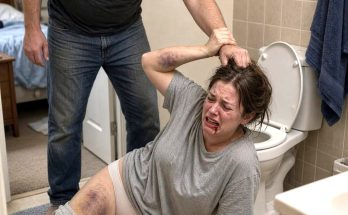
The door remained half open.
My husband stood on the other side.
Neither of us moved.
The monitor continued to hiss from the sink.
My son was quiet against my chest, his tiny breaths warming the skin beneath my chin.
Then my husband looked directly at the phone in my hand.
“You're recording me?”
“No.”
His eyes narrowed.
“Who are you talking to?”
I said nothing.
The dispatcher spoke through the phone.
Her voice was low enough that only I could hear it clearly.
“Do not tell him anything about our conversation.”
I kept the phone against my body.
My husband noticed the movement.
His face hardened.
“You called someone.”
I remained silent.
His mother appeared behind him.
She looked at me through the opening.
“Who did you call?”
I didn't answer her either.
For once, silence felt safer than explanation.
My husband pushed the door slightly wider.
I stepped back.
He stopped.
“I'm not going to hurt you.”
I looked at the swelling on my cheek.
He followed my eyes.
For a second, something like embarrassment crossed his face.
Then it disappeared.
“You know that wasn't supposed to happen.”
The sentence made my stomach tighten.
Not supposed to happen.
Not I shouldn't have done that.
Not I'm sorry.
He was already separating the act from responsibility.
I said, “You grabbed me.”
“I was angry.”
“You pulled my hair.”
“I lost my temper.”
“You held me down.”
He looked away.
“And your mother took our baby.”
“She was trying to help.”
“She threw him.”
His mother stepped forward.
“I did not throw him.”
I stared at her.
“You put him down.”
“That's not the same thing.”
The argument was so absurd that I almost couldn't respond.
My husband glanced at her.
“Mom.”
She stopped.
I realized then that even they couldn't agree on which version of the truth they wanted to use.
The monitor solved that problem.
A recorded voice came through.
My mother-in-law.
“She needs to understand that we can take the baby if we have to.”
My husband's voice answered.
“Don't say that where she can hear you.”
My breath caught.
His mother went still.
My husband looked at the monitor.
Then at me.
The color drained from his face.
For the first time, he seemed to understand the full danger of the device sitting on the sink.
I wasn't the only person hearing them.
The dispatcher was hearing them too.
His mother turned toward him.
“Turn it off.”
He didn't move.
“Turn it off!”
He stepped inside the bathroom.
I immediately moved backward.
“Don't come closer.”
He stopped.
My son began stirring.
I pressed my lips to his forehead.
My husband looked at the baby.
“I'm his father.”
I didn't answer.
“I have rights.”
“Then let the police decide what those rights are.”
His face tightened.
“You really called them.”
I said nothing.
He looked at his mother.
She looked back at him.
Something passed between them.
Fear.
Not fear for me.
Fear of consequences.
That realization gave me more strength than any speech could have.
My husband stepped back into the hallway.
“Mom, get the monitor.”
She moved toward the sink.
I raised my voice for the first time.
“Don't touch it.”
She stopped.
The dispatcher immediately asked what was happening.
“My mother-in-law is trying to take the monitor.”
My husband's head snapped toward me.
His mother froze.
Nobody spoke.
Then a sound came from outside the house.
A vehicle.
Another one.
The tires stopped somewhere near the driveway.
My husband turned his head.
His mother whispered, “Already?”
He looked at her sharply.
“What did you say?”
She didn't answer.
That was the moment I knew help was coming.
The dispatcher said, “Stay where you are.”
I nodded.
My husband moved toward the front of the house.
His mother followed.
Then he stopped and looked back at me.
“Don't say anything.”
I stared at him.
“You don't get to tell me that anymore.”
He opened his mouth.
Nothing came out.
Then he left the bathroom doorway.
His mother followed him.
For the first time since the attack, there was distance between us.
I didn't waste it.
I kept my son in my arms.
I stayed on the phone.
The monitor remained where it was.
Then I heard voices outside.
Firm voices.
Questions.
Footsteps.
My husband began answering.
His tone changed instantly.
Calm.
Polite.
Almost offended.
I knew that voice.
It was the same voice he had used when pretending to restore order.
Someone asked what had happened.
My husband said there had been a family argument.
My heart sank.
He was already rewriting it.
I moved closer to the bathroom doorway but stayed behind the wall.
I could hear another voice asking whether anyone had been injured.
My husband said no.
I looked at my bloodied lip.
No.
He said nobody had been injured.
Then the monitor played the recording.
His own voice filled the hallway.
“If she tries to leave with him, I'll stop her at the front door.”
The voices outside went silent.
My husband said something I couldn't make out.
Another person asked where the monitor was.
My mother-in-law said it was nothing.
The monitor answered for her.
“She'll give in when she thinks everyone is against her.”
Silence again.
Then footsteps came toward the bathroom.
My husband appeared in the doorway.
Behind him stood people I couldn't fully see.
He looked at me.
His face was different now.
Not angry.
Not gentle.
Afraid.
One of the people behind him asked me if I was hurt.
I nodded.
They asked whether my baby was hurt.
I shook my head.
They asked me to come out.
I looked at the dispatcher.
She told me I could move when I felt safe.
I gathered the towel around my son and stepped carefully into the hallway.
My knees were weak.
The first person immediately positioned themselves between me and my husband.
That small movement almost made me cry.
Not because I was helpless.
Because for the first time, someone else was creating the distance I had been struggling to create alone.
My husband started talking.
“She misunderstood everything.”
His mother joined him.
“She has been exhausted and emotional.”
I looked at them.
Then at the monitor.
I didn't need to answer.
One of the people in the hallway asked my husband whether he had put his hands on me.
He hesitated.
That hesitation was enough.
“Yes or no?”
He looked down.
“I grabbed her.”
His mother said, “He didn't mean—”
“Ma'am,” the person interrupted. “Let her finish.”
My husband looked at me.
For a moment, I saw the man I had married.
Or at least the version of him I had spent years believing existed.
Then I remembered the recording.
I remembered him planning to stop me.
I remembered his mother discussing my exhaustion as though it were a tool.
I remembered my baby being taken from me.
The illusion didn't return.
Someone asked me to describe what had happened.
My voice shook.
But I spoke.
I told them about my husband grabbing my hair.
I told them about being pulled to the floor.
I told them about my mother-in-law taking the baby.
I told them about the mattress.
I told them about the bathroom.
Then I told them about the monitor.
I didn't embellish anything.
I didn't need to.
The recording did the rest.
They listened to several portions.
My husband tried to explain.
“It sounds worse than it was.”
One of the responders looked at him.
“You said you would stop her from leaving with the baby.”
“I was angry.”
“You also discussed taking the child.”
“That was my mother.”
His mother looked at him.
“You agreed.”
He turned toward her.
“I never said that.”
The room changed.
For the first time, they were no longer united.
They were protecting themselves from each other.
My son made a small sound.
I looked down.
His eyes opened.
He stared up at me, completely unaware of the people around us.
I kissed his forehead.
One of the responders asked if I wanted medical attention.
I said yes.
My husband immediately said, “She doesn't need a hospital.”
I looked at him.
The responder did too.
Then my husband stopped speaking.
A few minutes later, I was sitting in the back of an ambulance with my baby beside me.
My hands were still shaking.
The paramedic examined my face and shoulder.
There were bruises.
A cut inside my lip.
Tenderness along my scalp.
None of it felt real.
The reality was my son's weight against my chest.
The reality was the phone still in my hand.
The reality was that I was leaving the house.
I looked back through the open ambulance doors.
My husband stood near the front steps.
His mother was beside him.
They were speaking to someone.
Neither looked toward me.
For a moment, I wondered whether I should feel victorious.
I didn't.
I felt empty.
There was no victory in discovering that the person you trusted had planned how to control you.
There was only the painful relief of finally seeing the truth.
The ambulance doors closed.
My son moved against me.
I whispered, “We're going somewhere safe.”
The words were meant for him.
But they were also meant for me.
At the hospital, doctors examined my injuries while someone from law enforcement took my statement.
The baby was checked too.
Thankfully, he had no serious injury.
That was the only piece of good news I could hold onto.
When the questioning ended, the officer asked whether I had any evidence.
I thought about the monitor.
“Yes,” I said.
The recording was preserved.
My phone call was documented.
The bruises were photographed.
The statements had been taken.
For the first time, the story no longer depended on whether my husband sounded convincing.
It existed outside of him.
Later that night, I sat in a quiet hospital room with my sleeping son.
I watched his chest rise and fall.
I thought about the bathroom.
The cold floor.
The key.
The door.
The recording.
But one question remained.
Why had they been so determined to keep me from leaving?
The recording had answered part of that.
They wanted control.
They wanted my exhaustion to work in their favor.
But there had been something else in their voices.
Something they had been afraid I would discover.
Something they had discussed before the attack.
Something they believed would matter if I ever got out of the house and started asking questions.
I remembered my mother-in-law's frightened voice.
“If she gets out, she'll tell them everything.”
Everything.
Not just about the assault.
Not just about the baby.
Everything.
I looked at my sleeping son.
Then at the hospital room door.
For the first time since the emergency call, I felt a different kind of fear.
The recording had saved me from the bathroom.
But it had also opened a door to a secret I still didn't understand.
And whatever that secret was, my husband and his mother had been willing to hurt me to keep it buried.
Click here to continue reading: PART 4: Leaving the House Should Have Been the End of the Nightmare, Until One Recorded Sentence Made Me Question Why They Needed Me Silent
The Door Was Locked, My Baby Was in My Arms, and Then the Monitor Played a Conversation I Was Never Supposed to Hear
Part 3 of 8