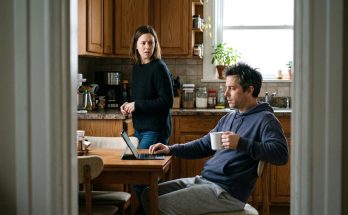
Mark asked to meet at a quiet park on the edge of town.
I almost refused.
Then I remembered what Samuel had said.
People reveal themselves through what they do after they are confronted.
So I went.
Mark was sitting on a bench beneath a bare maple tree.
He looked older than he had a month earlier.
His shoulders were bent.
His hands were clasped between his knees.
When he saw me, he stood.
“Thank you for coming.”
“I won't stay long.”
“I understand.”
I sat on the opposite end of the bench.
For a while, we listened to traffic.
Then Mark said, “I want to tell you everything without defending myself.”
I looked at him.
“Go ahead.”
He took a breath.
“I started planning because I was afraid.”
“I know.”
“But fear doesn't excuse what I did.”
“No.”
“I kept telling myself that if we had enough money, everything would be safe.”
“Safe for whom?”
“For everyone.”
He shook his head.
“That was a lie I told myself.”
He explained that his father's business had failed when Mark was sixteen.
Creditors had taken their house.
His mother had worked nights.
Mark had spent years believing poverty was one unexpected event away.
When he married me, he loved the stability we created together.
But he never stopped fearing its loss.
Then Dad sold the company.
Mark saw the numbers.
He imagined a future where work was optional.
At first, he told himself he was only planning.
Then planning became expectation.
Expectation became entitlement.
And entitlement became control.
“I crossed the line one decision at a time,” he said.
I looked at him.
“When did you know?”
“That I was doing something wrong?”
“Yes.”
He looked at the ground.
“When I opened the old tax file.”
“And?”
“I saw your signature.”
He admitted he had scanned it.
He created the authorization.
He told himself it was temporary.
He planned to transfer the money, secure the lake property, pay Diane's debts, and then tell me.
“When you say tell me, you mean after the fact.”
“Yes.”
I nodded.
“That isn't consent.”
“I know.”
“Did you ever think about what would happen if I said no?”
He looked at me.
“Not enough.”
“That's the problem.”
He wiped his eyes.
“I thought because we were married, you would eventually understand.”
“I might have.”
“I know.”
“But you never gave me the chance.”
He nodded.
The silence between us felt different now.
Not hostile.
Not forgiving.
Simply honest.
“Did you love me while you were doing it?”
His answer came immediately.
“Yes.”
“Then why did you treat me like an obstacle?”
He looked devastated.
“Because I loved what I thought our life could become more than I respected your right to choose it.”
That was the most honest thing he had said.
I looked away.
The wind moved through the dry leaves.
“What will happen now?”
“I don't know.”
“I'll accept whatever happens.”
“The legal consequences?”
“Yes.”
“You could fight.”
“I could.”
“Will you?”
“No.”
I turned toward him.
“Why?”
“Because I don't want to spend the rest of my life pretending I didn't do this.”
His answer surprised me.
The investigators had told me that Mark's cooperation could matter.
He had already provided access to his records.
He had admitted creating the forged document.
He had withdrawn the lake-house agreement.
He had dissolved the company structure.
But none of that restored the trust he had broken.
I stood.
“I need time.”
“I know.”
“Not because I don't care.”
“I know.”
“Because I need to know who I am without being responsible for fixing what you broke.”
He nodded.
As I walked away, he called my name.
I stopped.
“Clare?”
“Yes?”
“I never stopped loving you.”
I didn't turn around.
“I know.”
Three months passed.
The legal case moved forward.
Mark pleaded to the charges connected to the forged financial authorization.
Because he cooperated, returned documents, and accepted responsibility, the eventual consequences were less severe than they might have been.
He had to pay restitution related to the costs created by his actions.
MDC Family Holdings was dissolved.
Diane kept her own savings and moved into a smaller apartment.
Melissa sold her failing business, paid what she could, and began working for another company.
She and I spoke occasionally.
Our relationship was never the same.
But there was no hatred between us.
She had made a mistake by trusting Mark.
I had made a mistake by trusting that love automatically meant honesty.
Neither mistake could be undone.
The $3.8 million trust remained untouched.
I did not buy a lake house.
I did not buy a new car.
I did not announce my inheritance to anyone.
Instead, I hired an independent financial adviser.
For the first time in my life, I learned every detail of my finances.
Not because Dad had failed to teach me.
Because I had never thought I needed to know.
I discovered that money was not freedom by itself.
Knowledge was.
Boundaries were.
The ability to say no was.
The hidden $650,000 account became my emergency reserve.
I never told anyone outside my attorney and adviser about it.
Not even Mark.
One afternoon, nearly four months after Dad died, I visited his grave.
The cemetery was quiet.
The grass had begun turning green again.
I placed a small bouquet beside the stone.
“I found it,” I whispered.
A ridiculous thing to say to someone who couldn't answer.
But I said it anyway.
“I understand now.”
I sat there for a while.
Then I heard footsteps.
It was Mark.
He stopped several feet away.
“I won't stay.”
I nodded.
He placed a single white rose near Dad's grave.
“I wanted to say goodbye.”
I looked at him.
“To Dad?”
“To the man who gave me more chances than I deserved.”
I said nothing.
He turned to leave.
“Mark.”
He stopped.
“Are you working?”
“Yes.”
“Where?”
“A small consulting firm.”
“Do you like it?”
He smiled faintly.
“I hate the paperwork.”
For the first time in months, I almost smiled.
“Good.”
He looked at me.
“Clare.”
“What?”
“I'm learning to live with what I did.”
“I hope you are.”
“I don't expect you to come back.”
That mattered.
Because for months, every conversation had carried an expectation.
Now there wasn't one.
“I appreciate that,” I said.
He nodded and walked away.
I stayed beside Dad's grave.
I thought about the man Mark had been.
The man he became.
And the possibility that people could change only after they stopped trying to control the consequences of their actions.
That evening, I received an email from Samuel.
The final trust documents were ready.
There was one last decision.
The trust allowed me to establish a charitable fund in Dad's name.
I knew immediately what I wanted.
Dad had built his company from nothing.
He had hired people who needed second chances.
He had believed money mattered most when it gave someone the ability to build something.
So I created the Walter Hail Opportunity Fund.
It would provide small grants for young people starting businesses, learning trades, or returning to school.
No family member could apply.
No spouse could control it.
No one could promise it to someone else.
I wanted Dad's money to do what he had intended.
Give people choices.
Not obligations.
A year after Dad's death, I returned to the house.
The rooms felt different.
Not empty.
Mine.
I stood in the kitchen where Mark had first told me he had quit.
I remembered his words.
Why keep grinding away?
At the time, I had thought he was asking why either of us should keep working.
Now I understood the question differently.
There was nothing wrong with wanting a different life.
The wrong was deciding that another person's resources gave you the right to choose that life for them.
I sold the house a few months later.
Not because I couldn't bear the memories.
Because I no longer needed to live inside them.
I kept Dad's desk.
His blue tie.
His old watch.
And the letter.
Everything else went.
The money remained.
But it no longer frightened me.
It no longer represented my father's death.
It represented the choice he had wanted me to have.
Click here to continue reading: PART 11: A Year After Dad’s Death, I Learned That the Hardest Part Was Not Forgiving Mark but Accepting Why My Father Had Protected Me
Three Days After My Father’s Funeral Plans Began, My Husband Made a Decision That Forced Me to Question What He Had Been Planning All Along
Part 10 of 12