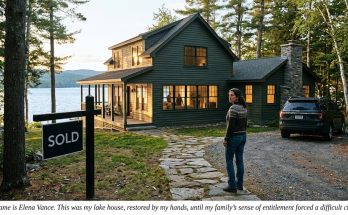
The house felt different after Megan told me about the letter.
Every room suddenly seemed capable of hiding something.
I walked through the living room slowly.
The restored fireplace stood exactly where it had always been.
The stone surface was warm from the previous evening's fire.
I ran my fingers along the mantel.
Nothing.
I checked the cabinet beside the fireplace.
Nothing.
Then I remembered Grandpa's habit.
Whenever he wanted to keep something safe, he didn't put it somewhere clever.
He put it somewhere ordinary.
He once told me, “People search for secrets. They don't search for boring things.”
I smiled despite myself.
Then I remembered the old cedar chest upstairs.
It had belonged to him.
I climbed the stairs.
The floorboards creaked beneath my feet.
The hallway smelled faintly of cedar and dust.
The chest sat beneath the window.
I lifted the lid.
Inside were blankets, old fishing magazines, a wool coat, and several boxes of photographs.
I moved everything carefully.
At the bottom was a brown envelope.
My name was written across it.
Natalie.
I stopped breathing.
The handwriting was Grandpa's.
I picked up the envelope.
It wasn't sealed.
Inside was a single sheet of paper.
I unfolded it.
Natalie,
If you're reading this, I probably didn't get the chance to tell you everything myself.
I sat down on the floor.
The letter wasn't long.
But every sentence seemed to carry years with it.
Grandpa wrote that the house belonged to me.
Not the family.
Not my mother.
Me.
He explained that he knew my mother loved the property, but he believed she sometimes confused loving something with having a right to control it.
He wrote that he had deliberately left the house to me because he trusted me to decide what happened to it.
Then came the sentence that made me close my eyes.
If one day you decide to sell it, sell it without guilt.
I read it again.
Then again.
My grandfather had anticipated this.
Not my mother's behavior exactly.
But the possibility that someone would try to make me feel guilty for exercising ownership over something he had intentionally given me.
At the bottom, he wrote:
A gift is not a gift if the person receiving it must surrender it to everyone else.
I held the paper against my chest.
For several minutes, I didn't move.
Then I heard the front door open.
My mother.
I folded the letter and slipped it into my pocket.
She called my name.
I went downstairs.
She stood in the entryway holding a small cardboard box.
She looked at me.
“You found it.”
“Yes.”
Her face changed.
“I was hoping you wouldn't.”
“You knew where it was.”
“Yes.”
“How long?”
She looked down.
“Since before your grandfather died.”
I felt something tighten behind my ribs.
“You knew he left this to me.”
“Yes.”
“And you still submitted that document.”
She closed her eyes.
“I was afraid.”
“Of what?”
“That once you sold the house, you would stop being part of the family.”
I stared at her.
“You thought owning a house was the only reason I'd be part of the family?”
“No.”
“But that's what you acted like.”
She put the box on the table.
“I made mistakes.”
“You forged a document.”
“I know.”
“You tried to interfere with a legal sale.”
“I know.”
“You told me I wasn't welcome in my own house.”
Her eyes filled.
“I know.”
I looked at the box.
“What is in there?”
She hesitated.
“More of your grandfather's papers.”
“Why did you take them?”
“Because I thought there might be something that could stop the sale.”
I nodded slowly.
“So you were looking for evidence against me.”
“I was looking for a way to keep the family together.”
“No.”
My voice surprised both of us.
“You were looking for a way to keep control.”
She sat down.
For a while, she didn't speak.
Then she said, “Your grandfather and I fought about the house.”
“I know.”
“No. You don't.”
She looked at the floor.
“He knew I wanted it.”
“Why?”
“Because I grew up there.”
“You didn't grow up at the lake house.”
“I grew up with him.”
Her voice cracked.
“He taught me to fish there. He taught me to drive there. He took me there when I was a teenager and thought my life was over because a boy broke up with me.”
She laughed weakly.
“I thought that place belonged to both of us.”
I understood that.
More than I wanted to.
“But he gave it to me.”
“I know.”
“Why didn't you tell me?”
“Because I thought you'd change your mind.”
“I might have.”
“I hoped you would.”
I sat across from her.
“Mom, if you had asked me honestly, I might have let everyone keep using it.”
She looked up.
“Really?”
“Yes.”
“Then why didn't you?”
“Because nobody asked.”
That hurt her.
I could see it.
But it was true.
The family hadn't lost the house because I refused to share.
They lost access because they stopped treating access as something that required my consent.
My mother wiped her eyes.
“I was wrong.”
I didn't answer.
“I thought if I could stop the sale, we'd have time.”
“Time for what?”
“For you to remember that we're your family.”
I looked at her.
“I never forgot.”
She looked away.
“I did.”
The sentence stayed between us.
I picked up the letter Grandpa had written.
“He knew.”
She stared at it.
“He knew what you were like?”
“No.”
I shook my head.
“He knew what people can become when they think something belongs to them.”
My mother lowered her eyes.
“I am sorry.”
I believed that she was sorry.
That didn't mean I could undo what had happened.
Samuel arrived later that afternoon.
I showed him the letter.
He read it carefully.
“This is useful.”
“How?”
“It reinforces your grandfather's intent.”
“Will it fix the title issue?”
“Combined with the estate records, the deed, and the inconsistencies in your mother's document, it should help.”
I nodded.
Rachel called that evening.
“The buyer wants to know whether the sale can proceed.”
I looked out toward the lake.
“Yes,” I said.
“Are you sure?”
I thought about Grandpa.
The note.
The money.
The years of work.
My mother standing in the doorway.
The words you're not welcome here.
“Yes.”
“I'll tell him.”
The title company completed its review several days later.
The disputed document was rejected.
The sale could proceed.
My mother never challenged the decision.
She couldn't.
The evidence was too clear.
She had copied the signature.
She had used information that didn't exist when the document supposedly had been signed.
She had tried to create an ownership interest that was never there.
When she finally admitted what she had done, she said she believed she was protecting the family.
Samuel told her that good intentions did not change what the document was.
A false document was still false.
My mother packed her belongings quietly.
Richard helped.
Megan came too.
Nobody argued.
Nobody raised their voice.
The house that had once been full of laughter became almost painfully silent.
I stood in the kitchen while they carried boxes toward the cars.
Megan stopped beside me.
“I don't know what to say.”
“You don't have to say anything.”
She nodded.
“I should have supported you.”
“You should have asked me.”
“I know.”
She looked around the kitchen.
“Do you regret selling?”
I thought about it.
“Yes.”
She looked surprised.
I continued.
“I regret that it had to end this way.”
That was different.
I didn't regret protecting myself.
I didn't regret the sale.
I regretted what the family had become around the house.
When the final box was carried out, my mother remained in the doorway.
She looked around one last time.
Then she looked at me.
“Your grandfather would have wanted you to be happy.”
I swallowed.
“I know.”
She nodded.
Then she left.
The closing took place twelve days later.
The buyer's name was James Holloway.
He was a civil engineer who had recently lost his wife and wanted somewhere quiet to retire.
He arrived for the final walkthrough with a black Labrador.
The dog immediately ran toward the dock.
James laughed.
“He's already decided.”
I smiled.
“I think Grandpa would have liked him.”
James looked toward the fireplace.
“Did your grandfather build that?”
“Yes.”
“It shows.”
“What do you mean?”
“People don't build fireplaces like that anymore.”
He stood quietly for a moment.
Then he asked, “Would you mind if I kept it exactly as it is?”
“I'd prefer that.”
He nodded.
“I will.”
Before I left, I walked to the dock alone.
The water was calm.
The mountains reflected across the lake.
I remembered sitting there as a child.
I remembered Grandpa handing me my first fishing rod.
I remembered the years of renovation.
The money.
The weekends.
The arguments.
The day my mother told me I wasn't welcome.
And then I remembered the letter.
A gift is not a gift if the person receiving it must surrender it to everyone else.
I finally understood what he had meant.
Ownership wasn't the point.
Choice was.
He had trusted me with the choice.
My family had spent years trying to make that choice for me.
I took the old fishing photograph from my bag.
I had almost left it behind.
Instead, I held it against my chest.
Then I turned toward the house.
James was standing on the porch.
He raised a hand.
I raised mine.
And for the first time, I wasn't looking at the lake house as something I had lost.
I was looking at it as something I had been allowed to love, restore, and eventually release.
The money I received from the sale allowed me to pay the remaining renovation debt and settle the expenses connected to the property.
I put the rest toward a smaller cabin farther north.
It wasn't impressive.
The porch leaned slightly.
One bedroom was barely large enough for a queen-size bed.
The kitchen had old cabinets.
The wood stove smoked when the weather changed.
But when I turned the key in the front door, there was nobody inside waiting to tell me I had arrived at the wrong time.
Nobody had left a boat at the dock.
Nobody had rearranged the furniture.
Nobody had decided that because we shared blood, they automatically shared ownership.
I didn't invite anyone for the first weekend.
I sat on the porch alone.
The silence felt strange.
Then it felt good.
Months later, an envelope arrived.
It was from my mother.
Inside was a letter.
She apologized.
Not just for the forged document.
Not just for telling me I wasn't welcome.
She apologized for every year she had treated my boundaries as an insult.
She admitted she had convinced herself that because the property had belonged to Grandpa, she had inherited a right to it through him.
She said she finally understood that love did not create ownership.
I read the letter twice.
Then I folded it and put it in a drawer.
I wasn't ready to forgive her completely.
Maybe I never would.
But I no longer needed to punish her either.
Those were different things.
A week later, Megan called.
She told me Mom was trying to make things right.
Then she said something I hadn't expected.
“I think all of us got used to letting you pay for things because you rarely said no.”
I laughed quietly.
“That sounds terrible when you say it like that.”
“It was terrible.”
She paused.
“I should have noticed.”
“You're noticing now.”
“I am.”
That was enough for the moment.
A year after the sale, James sent me a photograph.
He was sitting on the dock with his black Labrador.
The restored fireplace was visible through the open doors behind him.
The lake was silver beneath the morning light.
On the back of the photograph, he had written:
Your grandfather built a beautiful place. Thank you for letting me care for it next.
I put the photograph beside Grandpa's fishing picture.
Then I stood at the window of my little cabin.
The lake outside was smaller than the one I had left behind.
The house was simpler.
The porch boards were uneven.
The walls needed painting.
But it was mine.
Not because I had paid for every repair.
Not because my name was on a deed.
Not because I could keep everyone else out.
It was mine because I had finally stopped confusing love with surrender.
My mother had once told me I wasn't welcome in my own home.
For a long time, I thought those words were the worst thing she had ever said to me.
They weren't.
The worst part was realizing how long I had accepted the idea behind them.
That someone else could decide whether I belonged somewhere I had earned, protected, and inherited.
Selling the lake house didn't erase what happened.
It didn't repair every relationship.
It didn't return the years I had spent trying to keep everyone comfortable.
But it gave me back something more important.
The right to choose.
And when I unlocked the door of my little cabin that evening, stepped inside, and heard only the quiet ticking of the old wall clock, I smiled.
No one had to welcome me.
I already belonged there.
Click here to continue reading: PART 5: The New Cabin Was Quiet, but Peace Did Not Erase What Happened, and My Mother’s Apology Forced Me to Reconsider What Forgiveness Could Mean
My Mother Closed the Door on Me at the House I Had Spent Years Saving, and That One Sentence Changed What I Was Willing to Tolerate
Part 4 of 8