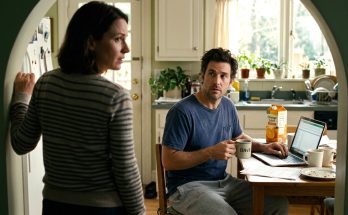
Three days after my father died, I walked into our kitchen and found my husband sitting at the table in gray sweatpants, drinking coffee at ten-thirty in the morning. That alone was unsettling. Mark had spent twenty-two years leaving the house before eight, even when he was sick. His work phone usually came before breakfast. That morning, it lay facedown beside an open laptop.
“Why are you home?”
He looked up as if I had asked something ordinary.
“I quit.”
For a second, I thought I had misunderstood him. The refrigerator hummed behind me, and somewhere upstairs a floorboard creaked as the house settled. My father’s funeral program was still on the counter. Sympathy cards leaned against the toaster. I still had Dad’s final voicemail on my phone because deleting it felt like agreeing that he would never call again.
“You quit your job?”
“Yesterday.”
“Without telling me?”
Mark leaned back and rubbed his thumb along the edge of his coffee mug. He had the calm expression he used when he believed I was worrying about something that did not require worry.
“I’ve been working for thirty-three years, Clare. I’m tired. I think I’ve earned the right to stop.”
I pulled out the chair opposite him but did not sit.
“With what money?”
He gave me a small smile.
“That’s exactly why I quit.”
I waited.
“Why keep grinding away?” he said. “Your inheritance is more than enough for us to live on.”
The words landed strangely. Not because I had never imagined Dad leaving me money. He had done well after selling Hail Mechanical, the heating and mechanical company he had built from a two-bay garage into a business with dozens of employees. But Dad had never discussed his wealth with me in any detail. He believed money was easier to manage when it wasn't constantly being talked about.
My husband, apparently, had discussed it enough for both of us.
“Dad died three days ago,” I said.
“I know.”
“And you’re already talking about my inheritance?”
“Our inheritance.”
I stared at him.
Mark lifted his hands slightly.
“We’re married, Clare.”
Before I could answer, his phone buzzed. He glanced at the screen, then stood.
“Mom and Melissa are coming over tonight.”
“For what?”
“To talk.”
“About Dad?”
“About everything.”
That evening, Diane arrived carrying a casserole dish covered in foil. Melissa came behind her, talking about a business loan she had been struggling to refinance. I remember noticing how ordinary the scene looked. My father had been buried only hours earlier, yet we were sitting around our dining table passing plates as though this were another Sunday dinner.
For twenty minutes, nobody mentioned money.
Then Diane sighed over her potatoes.
“My landlord raised the rent again.”
Mark set down his fork.
“Don’t worry, Mom. Once everything clears, I’ll buy you a house.”
My hand stopped halfway to my water glass.
Diane blinked.
“Mark.”
“I’m serious.”
Melissa laughed softly.
“Mom already has a house picked out in her head.”
“I do not,” Diane protested.
“You do.”
Mark smiled.
Then he looked at Melissa.
“And we’ll take care of your business debt, too.”
Her expression changed.
“What do you mean?”
“I’ll give you two hundred thousand. Enough to wipe everything clean and get you started again.”
Melissa stared at him.
“Are you serious?”
“Completely.”
She stood and hugged him.
I remained seated.
Nobody had asked me a question.
Nobody had asked what Dad had left. Nobody knew the exact terms of his estate. Nobody knew what I wanted. Yet within ten minutes, my husband had assigned hundreds of thousands of dollars to three people, including himself.
“Mark.”
He turned toward me.
“What?”
“Dad hasn’t even been buried.”
The room went quiet.
His smile disappeared.
“Clare, that’s not what this is.”
“What is it?”
“I’m taking care of family.”
I looked at Diane, then Melissa.
“Whose family?”
Diane lowered her eyes. Melissa suddenly became fascinated by her plate.
Mark’s jaw tightened.
“That was unnecessary.”
“So was promising two hundred thousand dollars that you don't control.”
Melissa raised both hands.
“I don't want to be in the middle of this.”
I almost laughed.
“You accepted two hundred thousand dollars thirty seconds ago.”
Her face reddened.
Mark pushed back his chair.
“Enough.”
“No,” I said quietly. “Not enough. Not even close.”
After they left, Mark followed me into the kitchen while I covered the leftover food.
“You embarrassed my mother.”
I turned.
“I embarrassed your mother?”
“She already feels uncomfortable accepting help.”
“She seemed to recover.”
His expression hardened.
“Why are you making this difficult?”
I smoothed the foil over the dish.
“You promised your mother a house and your sister two hundred thousand dollars without asking me.”
“We’re married.”
“That is not an answer.”
“It means we share things.”
“Then why did you quit your job without talking to me?”
He had no immediate reply.
I looked at him.
“That decision affected both of us, too.”
He sighed.
“I was tired.”
“So you made a decision about our future alone.”
“I thought I was doing something good for us.”
“You were doing something with money that doesn't belong to you yet.”
He stepped closer.
“Clare, there isn't going to be your money and my money. We're set.”
That sentence stayed with me long after he went upstairs.
Not because married people shouldn't share money. Mark and I had shared bills, vacations, mortgage payments, repairs, and twenty-two years of ordinary life.
The problem was that he had skipped the part where I was supposed to have a voice.
The next morning, I drove to Dad’s house to choose the suit he would wear for the funeral.
His bedroom smelled faintly of aftershave and cedar. His reading glasses sat on the dresser beside a hardware-store receipt. The blue tie Mom had given him years earlier hung from the closet door.
I touched it but didn't take it down.
My phone rang.
“Clare? This is Samuel Green.”
Dad’s estate attorney.
After the condolences and practical questions, Samuel said, “There are several documents Walter wanted me to review with you.”
“Can Mark come?”
There was a pause.
“Actually, your father specifically asked that our first meeting be with you alone.”
I looked toward the bedroom doorway.
“Did Dad say why?”
“He was very specific.”
My stomach tightened.
“All right.”
“Tomorrow morning?”
“Yes.”
Before hanging up, Samuel added, “And Clare?”
“Yes?”
“Bring identification and nothing else.”
That night, Mark asked what Samuel wanted.
“Estate paperwork.”
“Did he give you any numbers?”
“No.”
“Did he say how much?”
“No.”
Mark nodded, but the disappointment on his face was unmistakable.
The following morning, I drove downtown and parked beside the old brick building where Samuel had kept his office for years. The lobby smelled faintly of floor polish and coffee. A receptionist directed me upstairs.
Samuel met me at the elevator.
He looked older than he had at Dad’s funeral.
Inside his office, he had placed a box of tissues on the table.
I almost smiled.
“I’m not going to cry.”
He looked at me gently.
“You don't have to decide that in advance.”
We discussed certificates, the house, accounts, the company sale, and ordinary estate matters.
Then Samuel closed the first folder.
“Before we talk about the numbers, Walter left specific instructions.”
My back stiffened.
“What kind?”
Samuel opened a second folder.
“Clare, did Mark ever tell you that he met with your father privately?”
I stared at him.
“No.”
Samuel nodded slowly.
“Your father documented three contacts. One visit, one phone call, and one email.”
“What were they about?”
Samuel looked at me for a moment.
“Your inheritance.”
I felt the room become strangely quiet.
“Why would Mark be discussing that with Dad?”
“That's what Walter wanted you to understand.”
Samuel slid a handwritten letter across the table.
I recognized Dad’s handwriting immediately—blocky capital letters, the same style he had used on mechanical drawings for decades.
My fingers trembled as I unfolded the page.
The first paragraph was simple.
Dad wrote that Mark had visited him months earlier and begun asking questions about retirement.
Then I reached the sentence that made my breath catch.
Mark had told my father that once I inherited, he would finally be able to stop working.
Dad's response had been only two words.
Clare inherits.
I read the sentence again.
Then again.
“Dad wrote this down?”
“Yes.”
“Why?”
Samuel looked at me.
“Because Walter believed words mattered when money was involved.”
I lowered the letter.
“What else did Mark say?”
Samuel reached for another page.
“He asked what would happen to the estate when Walter died.”
I stared at the papers.
My father had been sick.
My husband had been planning.
And suddenly the kitchen conversation from three days earlier felt very different.
Samuel opened the final document.
“There's something else.”
I looked up.
“Your father changed his estate plan after that conversation.”
My heart began beating harder.
“How much?”
“Approximately three point eight million dollars in assets, excluding the house.”
I swallowed.
“That much?”
“Yes.”
Then Samuel leaned forward.
“But your father did something unusual.”
He placed a trust document in front of me.
“Most of the estate is protected.”
I read the first page.
My name appeared as beneficiary.
Mark's name did not.
“What does protected mean?”
“It means nobody gets to pressure you into making a decision while you're grieving.”
I looked at Samuel.
“Did Dad not trust Mark?”
Samuel was quiet for a long moment.
Then he said, “Your father didn't want to leave you his opinion of your husband along with his money.”
I felt something crack inside me.
Dad had known me too well.
He knew I would defend Mark.
Even when I shouldn't.
I folded the letter carefully.
“What am I supposed to do now?”
Samuel answered without hesitation.
“For the first time in a long time, Clare, you are supposed to make a decision because you want it—not because someone else expects it.”
Click here to continue reading: PART 2: The Estate Attorney Asked One Question, Then Showed Me the Documents My Husband Had Been Building While My Father Was Still Alive
My Father Was Barely Buried When My Husband Started Spending Money That Had Not Even Reached My Hands
Part 1 of 12