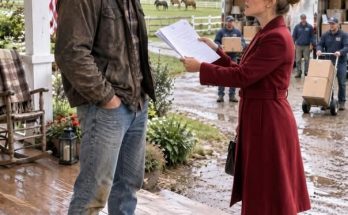
The trucks stopped near the front gate.
I could hear engines idling from the farmhouse.
Three men climbed out of the first truck. Another two stood beside the second, looking toward the house.
Clare stepped from her SUV wearing a dark coat.
She didn't wave.
She simply pointed toward the farmhouse.
One of the movers started walking forward.
I met them halfway.
“Who hired you?”
The man checked his clipboard.
“Clare.”
“Then you need to talk to Clare.”
“She told us everything was settled.”
“It isn't.”
He looked uncomfortable.
I handed him a copy of the legal documents my attorney had prepared.
He read the first page.
Then the second.
His expression changed.
“I’m not getting involved in this.”
“Good.”
He walked back toward the truck.
Clare approached.
“What did you do?”
“Nothing.”
“You're interfering with my movers.”
“Your movers are on property you don't control.”
She laughed.
“You really think that LLC protects you?”
“I think paperwork matters.”
Her jaw tightened.
She turned toward the movers.
“Leave.”
They loaded their equipment back into the trucks.
Before getting into her SUV, Clare looked at me.
“This isn't finished.”
“I know.”
She drove away.
I expected another confrontation.
Instead, the next week was silent.
No phone calls.
No texts.
No visits.
Nothing.
That silence bothered me more than the arguments had.
Then one morning, I walked to the mailbox and found an envelope.
It was addressed to me as a tenant.
I opened it standing beside the driveway.
The letter claimed that the property owner was increasing my rent by sixty percent.
I read it twice.
Then I laughed.
Not because it was funny.
Because the absurdity of it left me with nothing else to do.
I owned the ranch.
At least, that was what every document I possessed said.
I called the number on the letter.
Clare answered.
“Hello?”
“You sent me a rent increase.”
“Oh.”
There was a pause.
“It's probably an administrative issue.”
“Administrative issue?”
“Yes.”
“I don't pay rent.”
“I know.”
“Then why am I receiving a rent notice?”
She sighed.
“Jacob, you need to start thinking practically.”
“I am.”
“You can't manage that property forever.”
“I've managed it for years.”
“That's different now.”
“Different how?”
She didn't answer.
Then she said quietly, “You should start considering your options.”
I ended the call.
After that, Clare and Daniel began appearing at the ranch without warning.
Sometimes they stayed in their vehicle.
Sometimes they walked around.
Once, I found them measuring the kitchen counters.
“What are you doing?”
Clare looked over her shoulder.
“Relax.”
“This is my house.”
“We're just looking.”
Daniel held the tape measure.
He didn't say anything.
I wanted to order them off the property.
Instead, I remembered what my lawyer had told me.
“Document everything.”
So I began keeping records.
Dates.
Times.
Copies of letters.
Screenshots of messages.
Descriptions of every visit.
I wrote down exactly what was said whenever I could.
I even photographed the envelope containing the rent notice.
My lawyer explained why.
“You don't win a property dispute by getting louder.”
He tapped the folder on his desk.
“You win by proving what happened.”
I started a notebook.
The first page had only three words.
Facts. Dates. Evidence.
Then something happened that changed how I understood Clare's intentions.
It was a Saturday afternoon.
I was repairing a section of fencing near the rear pasture when I heard voices near the barn.
I recognized Clare immediately.
I crouched behind a stack of old lumber.
She was standing with two men I had never seen before.
One held a tablet.
The other was looking toward the hillside.
Clare pointed toward the western acreage.
“If we get control of the property,” she said, “that whole area becomes valuable.”
The man with the tablet asked something I couldn't hear.
Clare answered.
“We could sell it for much more than the current valuation.”
I stayed still.
Then she said something else.
That was the sentence I remembered most clearly.
“This land is worth more than what the family thinks.”
I waited until they left.
Then I returned to the fence.
My hands were shaking.
Until then, part of me had believed Clare wanted the ranch because she thought I was incapable of caring for it.
Now I understood.
She wanted the property because she saw an opportunity.
That distinction mattered.
To me, the ranch was where our parents had lived.
To her, it was an asset.
A valuable one.
At Thanksgiving, the tension became impossible to ignore.
Our relatives gathered at Aunt Linda’s house.
There was turkey, mashed potatoes, green beans, and the usual arguments about football and weather.
Then Clare stood with her glass raised.
“I've got some exciting plans for the ranch,” she announced.
I looked up.
Several relatives congratulated her.
My uncle even raised his glass.
I said nothing.
After dinner, Clare caught me in the hallway.
“You could make this easier.”
“For who?”
“For everyone.”
“You're asking me to give up my home.”
“I’m offering you a reasonable arrangement.”
“Which is?”
“You sign the property over. We let you stay for a while.”
I stared at her.
“You don't get to let me stay.”
Her expression changed.
“You're being emotional.”
“No. I'm being specific.”
She stepped closer.
“You really think that little company you created makes you untouchable?”
I didn't answer.
She lowered her voice.
“Structures like that can be challenged.”
Then she walked away.
That night, I barely slept.
The next morning, I called my lawyer.
“She knows about the LLC.”
“I assumed she would eventually.”
“Can she destroy it?”
“Anything can be challenged. That doesn't mean it can be successfully challenged.”
“So what do I do?”
“Keep documenting. Keep the business records clean. Don't transfer anything casually. Don't make statements you don't mean.”
I followed his instructions.
Then Clare escalated.
First came a complaint about the property.
Then a county inspection.
Then another letter.
Then a noise complaint because I had been mowing in the morning.
The complaints were small individually.
Together, they became exhausting.
Every few days, another envelope arrived.
I began checking the mailbox with a knot in my stomach.
One stormy night, headlights swept across the living-room wall.
I opened the door.
Daniel stood on the porch.
He handed me a packet.
“We're serving notice.”
“What kind of notice?”
He didn't answer.
He turned and walked back toward the SUV.
I closed the door.
Rain struck the windows.
I sat at the kitchen table and opened the packet.
It wasn't an eviction notice exactly.
It was a legal challenge to my ownership.
I read it once.
Then again.
My parents had been gone for less than a year.
Already, their children were fighting over what they had left behind.
I looked around the kitchen.
Mom's old wooden cutting board was still beside the sink.
Dad's coffee mug sat in the cabinet.
For the first time, I realized I could not solve this by hoping Clare would remember we were family.
I needed to prepare.
The next morning, I met my lawyer.
He brought out a large file.
“We need everything,” he said.
“The will?”
“Yes.”
“The deed?”
“Yes.”
“LLC records?”
“Absolutely.”
“Tax payments?”
“Every one.”
“Maintenance records?”
“All of them.”
So we started collecting.
Property-tax receipts.
Feed invoices.
Equipment purchases.
Contractor bills.
Fence repairs.
Roof repairs.
Insurance documents.
Bank statements.
Photographs.
Anything showing that I had actually operated and maintained the ranch.
The more records we gathered, the more the dispute began to look different.
This wasn't simply about a piece of land.
There was a history behind my ownership.
A history Clare could not erase by filing papers.
But I didn't yet know how far she was willing to go.
I found out the following Tuesday.
I was feeding the horses when several engines appeared at the end of the driveway.
Two moving trucks.
Three cars.
And Clare's SUV.
She stepped out carrying an umbrella.
She looked directly at me.
Then she pointed toward the trucks.
“We're getting started.”
My stomach dropped.
“Started with what?”
“Packing.”
She glanced toward the farmhouse.
“Renovations begin next week.”
The movers began unloading.
And Clare handed me a folder containing a court stamp.
Click here to continue reading: PART 3: Clare arrived with court papers, family signatures, and a recording of my own voice, forcing me to confront what she had prepared
The papers on my kitchen table looked ordinary until I realized my sister had already started planning a future that did not include me
Part 2 of 6