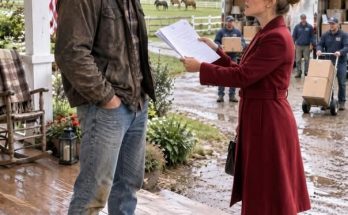
I held the folder without opening it.
“What's this?”
“The transfer documents.”
“I've already seen your transfer.”
“No.”
Clare shook her head.
“You haven't seen everything.”
The rain had stopped, but the sky remained gray.
Behind her, the movers waited beside the trucks.
I opened the folder.
There were court documents.
Affidavits.
Statements.
Copies of communications.
And several letters from relatives.
I recognized the names immediately.
My uncle.
Two cousins.
People who had stood beside me at the funeral.
People who had told me they were proud that I was keeping the ranch running.
Now they had signed statements supporting Clare's claim that I had received an unfair portion of the estate.
I looked up.
“You brought the family into this?”
Clare folded her arms.
“Someone had to be reasonable.”
“You told them I was trying to take everything.”
“I told them the truth.”
“No. You told them your version.”
Her fiancé stepped forward.
“Enough.”
I ignored him.
“What did you tell them?”
Clare looked toward the farmhouse.
“That you had the most valuable asset.”
“Because Mom and Dad wanted me to have it.”
“That's your interpretation.”
“It’s written in the will.”
“Things can be challenged.”
The words landed harder than I expected.
I looked at the movers.
“Nobody touches anything.”
One of them shrugged.
“We're just here to do a job.”
“You won't be doing it today.”
Clare smiled.
“You're still pretending you have control.”
Then she reached into her coat.
“I brought something else.”
She pulled out her phone.
My own voice came through the speaker.
At first, I didn't understand.
Then I recognized the conversation.
Months earlier, I had been sitting with a friend after a brutal week.
I had been exhausted.
Overwhelmed.
I had said something I barely remembered.
“Some days it would be easier to sell everything and walk away.”
The recording stopped.
Clare looked at me.
“There.”
I stared at her.
“You recorded that?”
“You never prepare for anything, Jacob.”
Her tone was almost gentle.
“Someone has to.”
I felt something cold settle in my chest.
“That was a private conversation.”
“And now it's evidence.”
I looked at her for several seconds.
The movers stood behind her.
Her attorney waited near the SUV.
The relatives had signed statements.
She had filed legal papers.
She had been gathering information for months.
This wasn't an emotional outburst.
It was a campaign.
And I had been treating it like a family argument.
I closed the folder.
“You're not moving anything today.”
Clare checked her watch.
“You have until Friday to leave.”
“No.”
She blinked.
“What?”
“I said no.”
Her face tightened.
“I don't think you understand what's happening.”
“I understand perfectly.”
“No, Jacob. You don't.”
She gestured toward the house.
“It's over.”
Then she turned toward the movers.
“Let's go.”
The movers didn't move.
One of them looked at me.
Then at Clare.
Finally, he shook his head.
“I'm not touching anything until your attorneys sort this out.”
Clare cursed under her breath.
The trucks eventually left.
She remained for another minute.
Then she got into her SUV.
Before closing the door, she looked at me.
“You're going to regret making this difficult.”
I watched her disappear down the driveway.
I stood there until the sound of the engines faded.
Then I went inside.
I closed the door.
I didn't shout.
I didn't call her.
I didn't send a message.
I simply sat in Dad's old chair.
For several minutes, I held his old work hat in my hands.
The leather was cracked around the brim.
There was still dirt trapped in the stitching.
I remembered him telling me something years earlier.
When a machine broke, Dad never attacked it.
He stopped.
He looked at it.
Then he figured out which part had failed.
That evening, I decided to do the same thing.
I would stop reacting.
I would examine the problem piece by piece.
The next morning, I met my attorney.
He had already reviewed Clare's filing.
“She got a transfer approved,” he said.
My stomach tightened.
“So she owns it?”
“Not necessarily.”
“What does that mean?”
“It means a recorded transfer isn't the end of the legal process.”
He spread several documents across the table.
“There are questions about how the transfer was obtained, what your parents actually intended, and whether the later documentation supports your position.”
“So we can reverse it?”
“Possibly.”
I leaned back.
“What do you need from me?”
“Everything.”
I gave him the files we had already collected.
Then I went home and searched through every drawer, cabinet, box, and filing cabinet in the farmhouse.
I found old tax receipts.
Horse-feed invoices.
Contractor statements.
Repair estimates.
Photographs.
Dad's notebooks.
Bank records.
A stack of handwritten maintenance logs.
Every piece added another layer to the history of the ranch.
I began creating binders.
One for the estate.
One for the property.
One for business records.
One for repairs.
One for witnesses.
I labeled every section.
I scanned documents.
I made copies.
I backed them up.
Then I contacted people who had known my parents.
One neighbor remembered Dad teaching me to repair fence posts.
A former ranch hand remembered how often I worked alongside him.
A feed supplier had years of invoices in my name.
Another neighbor had photographs.
I began to understand why my lawyer kept telling me records mattered.
Memory could be disputed.
Paper was harder to argue with.
Still, the emotional part was harder.
One evening, I loaded several boxes into my truck.
I sat behind the wheel.
For a moment, I considered leaving.
Maybe Clare was right.
Maybe the fight wasn't worth it.
Maybe I could sell what I had, move somewhere else, and start over.
I looked through the windshield.
The farmhouse was dark.
Dad's workshop stood behind it.
The barn roof needed repair.
The pasture fence needed another round of work.
The place was difficult.
Expensive.
Exhausting.
But it was home.
I turned off the truck.
I unloaded the boxes.
Then I walked the property line.
Dad used to do that whenever he had a serious decision to make.
He called it walking the land.
I walked until sunset.
The wind moved through the grass.
A horse whinnied near the barn.
Somewhere in the distance, a dog barked.
By the time I reached the farmhouse again, I knew what I was going to do.
I wasn't going to leave.
But I also wasn't going to turn this into a personal war.
I would let the documents speak.
Over the next several weeks, I treated the ranch differently.
Not just as my home.
As a business.
I opened a dedicated account.
I documented every expense.
I recorded every repair.
I kept copies of every payment.
I repaired the barn roof.
I replaced damaged fence posts.
I cleaned the equipment shed.
I began looking into agricultural programs I had ignored for years.
Then something unexpected happened.
A local riding instructor asked whether she could rent part of the pasture on weekends.
A photographer asked to use the property for a small number of outdoor sessions.
The income wasn't enormous.
But it was enough to prove something important.
The ranch could support itself.
I wasn't simply preserving the past.
I could build something there.
Meanwhile, Clare continued sending messages.
Move-out deadlines.
Warnings.
Legal notices.
I stopped responding directly.
Everything went through my lawyer.
That reduced the noise.
It also gave me room to think.
Then, while searching county records, I found something I had never seen before.
It was filed among older estate documents.
An addendum.
My father's signature was on the final page.
I read it once.
Then again.
The document explained why the ranch was intended for me.
It referred specifically to my long-term work maintaining and operating the property.
My hands started shaking.
I photographed every page.
Then I called my lawyer.
“Come to the county office.”
“Why?”
“I found something.”
He arrived later that afternoon.
He read the document silently.
Then he read it again.
Finally, he looked at me.
“This changes things considerably.”
I made certified copies.
We collected statements from neighbors and former workers.
One person had photographs of me repairing the barn with Dad.
Another had pictures of us baling hay.
Someone else remembered the years I had handled livestock and equipment.
The evidence was beginning to form a picture.
But then I learned something else.
I was sitting in a small diner when an old family friend, Mr. Collins, approached my table.
He lowered himself into the chair opposite me.
“I heard about the fight.”
I nodded.
He looked uncomfortable.
“There’s something you should know.”
“What?”
“Clare has been talking to developers.”
I stopped eating.
“What kind of developers?”
“People interested in resort and golf projects.”
My fork rested against the plate.
“Are you sure?”
“I wouldn't have told you if I wasn't.”
Then he added something that explained the urgency behind everything Clare had done.
“She and Daniel are having financial trouble.”
I stared at him.
“What kind?”
“I don't know all the details. But an investment went badly.”
The ranch suddenly looked different in my mind.
Clare wasn't simply trying to control an inheritance.
She needed an asset.
A valuable asset.
And my parents' ranch was worth more than enough to attract buyers.
That night, I called my attorney.
“We need to protect the property beyond the ownership dispute.”
He asked what I meant.
“I want to know whether there are lawful ways to preserve its agricultural use.”
He paused.
“That's worth investigating.”
We began looking into agricultural preservation and conservation options.
It took time.
There were applications.
Requirements.
Records.
Professional consultations.
Nothing happened overnight.
But eventually, I received confirmation that the property qualified for a preservation program that would provide certain benefits while making large-scale redevelopment considerably more complicated.
I read the paperwork three times.
The ranch would remain land.
Pasture.
Agricultural property.
Home.
Not simply a development site waiting for someone to cash out.
I did not tell Clare immediately.
I wanted my attorney to finish preparing the legal strategy first.
Then, late in January, Clare returned.
This time, she came only with Daniel.
She handed me another move-out notice.
I read it.
Folded it.
Placed it on the porch railing.
“Thanks.”
She frowned.
“For what?”
“It will be useful.”
“Useful for what?”
I looked at her.
“The court case.”
Her expression changed.
“What court case?”
“The one where we're challenging the transfer.”
Daniel laughed.
“You can try.”
“I intend to.”
I went inside.
When I returned, I carried one of my binders.
I opened it on the porch.
Estate documents.
Tax records.
Business records.
Photographs.
Witness statements.
Proof of years of work.
Then I placed the preservation paperwork on top.
Clare picked it up.
She read silently.
Her face changed.
“You did this?”
“I protected the property.”
“You're ruining everything.”
“No.”
I looked toward the hills.
“I'm making sure the ranch remains what Mom and Dad intended.”
For once, Clare had no immediate answer.
Click here to continue reading: PART 4: The hearing was approaching, but the thickening file on my lawyer’s desk contained one document Clare had never expected me to find
The papers on my kitchen table looked ordinary until I realized my sister had already started planning a future that did not include me
Part 3 of 6