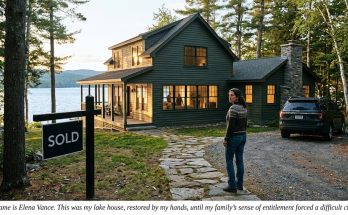
The first thing I noticed was the number of cars. Eight of them crowded the gravel driveway, two with their wheels half on the grass, and one blocking the narrow path that led toward the dock. Music drifted through the open windows. Someone was laughing near the firepit. A child shouted from the water.
I sat behind the steering wheel with both hands resting on my lap.
For a few seconds, I wondered whether I had somehow forgotten an important family gathering. Then I looked at the cooler strapped into the back of my SUV, the groceries I had bought for myself, and the small paper bag containing flowers for the kitchen table.
I hadn't forgotten anything.
Nobody had told me they were coming.
The house stood exactly as I remembered it from my grandfather's photographs, except that it no longer looked like a quiet retreat. Towels hung over the railing. Someone had dragged my outdoor chairs toward the firepit. A fishing boat floated beside the dock, its line tied to a post I had replaced only months earlier.
I turned off the engine.
My stomach tightened.
For six years, I had spent money I could barely spare restoring that house. I had replaced plumbing, repaired electrical work, rebuilt portions of the dock, installed windows, refinished floors, and restored the old stone fireplace my grandfather had built himself.
Nearly sixty-seven thousand dollars.
And now I couldn't even tell whether I was looking at my own home or somebody else's vacation rental.
I opened the car door.
Before I could reach the porch, the front door swung open.
My mother stood there with a glass of wine in one hand.
She didn't smile.
“Oh,” she said.
Just that.
Not hello.
Not I'm glad you're here.
Just, “Oh.”
I stopped at the bottom of the steps.
“You knew I was coming.”
She glanced over her shoulder toward the crowded living room.
“We're having people over.”
“I can see that.”
Her mouth tightened.
“Natalie, tonight isn't really a good time.”
I looked past her.
My sister Megan was sitting at the kitchen island with two women I didn't recognize. My stepfather Richard was outside talking to a couple beside the grill. One of Megan's children ran through the hallway carrying a wet towel.
I looked back at my mother.
“This is my house.”
She sighed as though I had just raised an embarrassing subject at the dinner table.
“I know that.”
“Then why are you standing in my doorway telling me tonight isn't a good time?”
Her voice dropped.
“Because everyone is relaxing, and when you're here, you start worrying about everything.”
“Everything?”
“The furniture. The dock. The towels. The children. Who used what.”
I stared at her.
“I ask people to respect things because I paid for them.”
“That's exactly what I mean.”
She looked toward the deck.
“They're having a nice evening. Don't make this difficult.”
Something cold settled in my chest.
“Mom, did you invite all these people?”
“Some of them.”
“And you didn't think to tell me?”
“You weren't planning to come until today.”
“I own the place. I shouldn't need an invitation.”
She looked at me for a long moment.
Then she said the sentence that would eventually cost our family far more than one uncomfortable evening.
“You're not welcome here tonight.”
There was music behind her.
Someone laughed.
The lake water slapped softly against the dock.
And somehow those ordinary sounds made her words feel even sharper.
I could have argued.
I could have pushed past her.
I could have called Richard outside and demanded that everyone leave.
Instead, I looked at my mother and said, “Okay.”
Her shoulders relaxed.
She thought she had won.
I walked back toward my SUV.
Halfway down the driveway, I looked over my shoulder.
The house had once been the place where I felt closest to my grandfather.
Now I was leaving it because my own mother had decided I was an inconvenience.
The drive home took almost ninety minutes.
At first, I was furious. Then embarrassed. Then strangely calm.
I kept thinking about the word family.
It had been used to excuse everything.
When my mother began keeping clothes in the upstairs closet, it was because she was family.
When Megan's children left toys on the floor, it was because they were family.
When Richard tied his boat to my dock without asking, it was because he was family.
When my mother changed the curtains without telling me, she said it was because she wanted the place to feel welcoming for everyone.
Whenever I objected, someone reminded me that family shared.
But somehow, I was always the one expected to share.
My money.
My time.
My house.
My patience.
I had spent years pretending that none of it bothered me because I was afraid that setting boundaries would make me look selfish.
That night, I finally wondered whether keeping the peace had simply taught everyone that I would eventually give in.
The house had not started this way.
When my grandfather Walter died, he left the property to me.
He had owned the lake house for decades. It sat outside Lake Chelan, surrounded by pine trees and steep hills, with the water visible from almost every room on the western side.
The property had been beautiful once.
By the time I inherited it, it needed serious work.
The roof leaked.
Several windows were warped.
The plumbing was unreliable.
The deck had soft spots where the boards had rotted.
The kitchen looked like it had been trapped in another decade.
But none of that bothered me.
I remembered being there with Grandpa when I was a child.
He taught me how to fish from the dock.
He showed me how to split kindling.
He would sit beside the stone fireplace on cold evenings and tell stories that somehow became longer every time he told them.
Before his death, he had left me a handwritten note with the estate papers.
Make this place yours before somebody else decides what it should mean to you.
I thought I understood the sentence.
I didn't.
I thought he meant the renovations.
So I started working.
I refinanced my small condo.
I took weekend consulting jobs.
I canceled vacations.
I drove to the lake after long workweeks and spent Saturdays covered in dust.
When the plumber gave me a number that made me stare at the estimate for nearly ten minutes, I signed anyway.
When the contractor told me the fireplace would be cheaper to replace than restore, I refused.
“My grandfather built it,” I said.
“It's going to cost more.”
“I know.”
“Then why restore it?”
“Because it was his.”
The work took years.
Little by little, the house changed.
The old windows were replaced.
The roof stopped leaking.
The deck became solid again.
The floors regained their natural color.
The dock was rebuilt after winter damage.
I planted shrubs along the side of the house and bought a heavy wooden dining table for the kitchen.
Eventually, the house felt alive again.
That was when my mother began calling it “our family lake house.”
The first time she said it, I laughed.
She didn't.
She simply nodded toward the property and said, “It's nice to have something for all of us.”
I didn't correct her.
When she asked whether she could spend a weekend there, I said yes.
Then Megan came.
Then Megan's husband.
Then the children.
At first, they asked.
Eventually, they stopped.
One summer, I arrived to find clothes hanging in the upstairs closet.
Another time, I opened the freezer and discovered food labeled with my mother's name.
Richard left fishing equipment in the garage.
Megan's children had toys under the sofa.
One afternoon, I discovered that my mother had replaced the curtains in the living room.
I stood there holding one of the old curtains.
“Why did you change these?”
She barely looked up from the box she was unpacking.
“They were too dark.”
“I liked them.”
“Natalie, they're curtains.”
“It's my house.”
She gave me the same answer she always gave.
“It's family.”
That phrase became a shield.
Anything I questioned could be defended with it.
And because I loved them, I kept backing away.
Until Memorial Day weekend.
Until eight cars filled my driveway.
Until my mother looked me in the face and told me I wasn't welcome.
When I reached my condo that night, I didn't unpack the groceries.
I left them in the SUV.
I walked inside, took off my shoes, and opened my laptop.
For months, a real-estate agent named Rachel Morgan had occasionally contacted me.
She represented a buyer who had fallen in love with the lake house.
I had always declined.
The house wasn't for sale.
It was Grandpa's.
It was family.
It was supposed to be something that lasted.
At 11:42 p.m., I found Rachel's email.
I typed four words.
Are they still interested?
Her response came less than ten minutes later.
Yes.
My pulse quickened.
I wrote again.
I'm ready to sell.
The phone rang almost immediately.
“Natalie?”
“Hi, Rachel.”
“Are you serious?”
“Yes.”
There was a pause.
“Do you want to talk tomorrow?”
“No.”
I looked toward the dark window.
“I've made my decision.”
Rachel's voice became careful.
“If you want to move quickly, I have a buyer who can.”
“Then let's move quickly.”
She asked whether anyone was currently staying at the property.
I looked at the family group chat.
My mother had posted a photograph of the lake.
The caption said:
Our favorite family place.
I stared at it for several seconds.
“Yes,” I said.
“They're there now.”
Rachel hesitated.
“Then we'll need to handle the occupancy carefully.”
I closed my laptop.
“They won't be there for long.”
The next morning, I sent written notice to everyone staying at the house.
The property was under contract.
Their permission to remain there was revoked.
Their belongings needed to be removed.
My mother called before I had even put down my phone.
“What is this?”
“I told you. I'm selling the house.”
“You can't.”
“I can.”
“Not Grandpa's house.”
“He left it to me.”
“He left it to the family.”
“No. He left it to me.”
Her breathing became heavier.
“You're angry because of yesterday.”
“Yes.”
“So you're throwing away your grandfather's house because I told you to leave?”
“No.”
I looked at the papers Rachel had sent me.
“I'm selling it because yesterday made me realize that I don't own a home. I own a building everyone else believes they have a right to control.”
She went silent.
Then she said, “You're making a terrible mistake.”
“Maybe.”
I paused.
“But it's my mistake to make.”
I ended the call.
For the first time since Grandpa's death, I felt like I had actually listened to what he had written.
Make this place yours before somebody else decides what it should mean to you.
I had spent six years restoring the house.
I had not realized until then that restoring the building was the easy part.
The harder restoration was deciding who I was allowed to be inside it.
Click here to continue reading: PART 2: The Sale Was Supposed to End the Argument, Until My Mother Produced a Paper That Made Me Question How Far She Was Willing to Go
My Mother Closed the Door on Me at the House I Had Spent Years Saving, and That One Sentence Changed What I Was Willing to Tolerate
Part 1 of 8