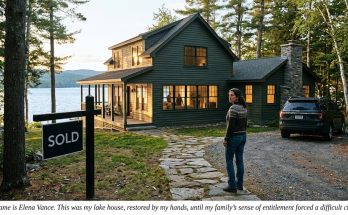
By Monday morning, the lake house was officially under contract.
I expected anger from my family.
I expected accusations.
I expected my mother to tell everyone that I had lost my mind.
What I didn't expect was how quickly they would rewrite the past.
Megan called first.
She didn't say hello.
“You can't do this.”
“I already did.”
“You're selling the only place we have.”
“No. I'm selling my property.”
She took a breath.
“Grandpa wanted us all to have it.”
“Did he tell you that?”
“He told Mom.”
“When?”
“I don't know.”
“Then why are you certain?”
Silence.
I heard one of her children talking somewhere in the background.
Finally, Megan said, “Because that's what family does.”
I closed my eyes.
There it was again.
Family.
A word that apparently meant I was responsible for everyone's memories, everyone's expectations, and everyone's access to something I had paid to restore.
“What did you contribute to the renovations?” I asked.
She went quiet.
“Megan.”
“I didn't have to.”
“That wasn't my question.”
She hung up.
A few minutes later, Rachel sent me an update.
The buyer had signed.
The inspection was scheduled.
The title company had started reviewing the records.
Everything appeared straightforward.
My name was on the deed.
My grandfather's estate had transferred the property to me.
The taxes were current.
There were no known liens.
I should have felt relieved.
Instead, I felt guilty.
That surprised me.
I had spent years allowing guilt to make decisions for me, so perhaps it shouldn't have.
I drove to the lake house that afternoon to check on the property.
The driveway looked different with fewer cars.
Megan's SUV was gone.
Richard's truck was gone.
My mother was still there.
She stood on the porch when I arrived.
“I told you to leave.”
She folded her arms.
“I live here when I'm here.”
“No, you don't.”
She looked offended.
“This is my father's house too.”
“Your father left it to me.”
“You keep saying that.”
“Because it's true.”
She stepped closer.
“You think money is everything.”
I almost laughed.
“No. I think ownership matters when someone is trying to sell something.”
She shook her head.
“You've become cold.”
“I became tired.”
That stopped her.
For a moment, neither of us spoke.
Then she said quietly, “You don't understand what this house means to me.”
I looked through the window toward the fireplace.
“I understand exactly what it means to you.”
“Then why would you sell it?”
“Because it doesn't mean the same thing to me anymore.”
She looked away.
I could see the anger returning.
“Your grandfather would be ashamed.”
That one hurt.
Not because I believed her.
Because she knew exactly where to aim.
I stepped onto the porch.
“Don't use Grandpa to make me feel guilty.”
“He loved this place.”
“So did I.”
“And you're destroying it.”
“No.”
I looked directly at her.
“I'm refusing to let everyone else decide what happens to it.”
She didn't answer.
I went inside.
The house smelled like smoke from the previous evening.
There were dishes in the sink.
A wet towel lay over one of the dining chairs.
I picked it up.
For a moment, I remembered being ten years old, sitting at the same table while Grandpa showed me how to clean fish.
The memory softened me.
Then I noticed a scratch across the tabletop.
A long, pale line near the edge.
I had refinished that table myself.
I ran my finger over the damage.
My mother watched me from the doorway.
“You're really doing this.”
“Yes.”
She shook her head.
“You'll regret it.”
Maybe I would.
But regret wasn't a reason to surrender ownership.
I spent that evening photographing the condition of the property and documenting the furniture and improvements.
Rachel had advised me to keep records.
I didn't know then how important that advice would become.
Two days later, I received an email from the title company.
There was a problem.
The message was brief.
Please call as soon as possible regarding a document submitted by Linda Harper concerning an alleged ownership interest.
I read it twice.
Then I called Rachel.
“What does that mean?”
Her voice was tense.
“Your mother contacted the title company.”
“About what?”
“She says she has documentation showing your grandfather intended to give her part of the property.”
I stared at the wall.
“That isn't possible.”
“That's what I thought.”
“Did she send the document?”
“Yes.”
“Send it to me.”
A few minutes later, the attachment appeared.
I opened it.
At first glance, it looked legitimate.
It contained the property description.
There was a signature at the bottom.
Walter Harper.
My grandfather.
My heart began beating faster.
I zoomed in.
The signature looked almost perfect.
Too perfect.
Then I saw the date.
October 9, 2019.
I leaned back.
That date wasn't just familiar.
I remembered exactly where I had been.
Grandpa had suffered his stroke a few days earlier.
He was in a hospital in Tacoma.
I had spent most of that week beside his bed.
His right side was badly affected.
His hand barely moved.
I remembered trying to help him hold a spoon.
I remembered him becoming frustrated because he couldn't grip it properly.
I remembered the nurse telling me not to ask him to sign anything until his condition stabilized.
The document in front of me claimed he had calmly signed a property agreement that same week.
I called Samuel Price, the attorney who had handled Grandpa's estate.
He listened without interrupting.
Then I forwarded the document.
“Don't confront her yet,” he said.
“Why?”
“Because we need to establish exactly what this is.”
“It has his signature.”
“That doesn't mean he signed it.”
“I know.”
Samuel paused.
“Let me compare it with the originals.”
The next morning, he called.
“Natalie, where did you get the date?”
“It's on the document.”
“No. I mean the date itself.”
“I told you. October 9, 2019.”
“That document cannot have been created on that date.”
My stomach tightened.
“Why?”
“Because the parcel number printed on it wasn't assigned until a later reassessment.”
I said nothing.
Samuel continued.
“The property description contains information that did not exist in the county records at the time the document supposedly originated.”
“So someone made it later.”
“That is what it appears.”
“And the signature?”
“I've compared it with authenticated documents from your grandfather.”
“What do you think?”
“I think someone copied it.”
I sat down.
For several seconds, I couldn't speak.
The situation had changed.
This wasn't my mother being difficult.
It wasn't my family refusing to respect my boundaries.
Someone had submitted a document claiming that my grandfather had transferred an interest in my property.
A document that appeared to contain information from years after the date written on it.
“Can she stop the sale?” I asked.
“Temporarily, yes.”
I closed my eyes.
“How long?”
“That depends on the title company's investigation.”
“And if they determine it's fraudulent?”
“Then the claim should be rejected. But we need to document everything.”
I hung up.
Then I called my mother.
She answered immediately.
“You spoke to the title company.”
“Yes.”
“I had to.”
“You submitted a document claiming Grandpa gave you part of my property.”
“It's not your property.”
“It is.”
“He wanted me to have it.”
“Then why didn't the estate records say so?”
She didn't answer.
“Mom.”
“I found the paper.”
“You didn't find it.”
Her voice hardened.
“You're accusing me of lying.”
“I am asking you where it came from.”
“I told you. Your grandfather signed it.”
I looked at the copy on my screen.
“Grandpa could barely move his hand that week.”
“He had good days.”
“No.”
I felt my voice becoming colder.
“I was there.”
“You weren't there every minute.”
The words stayed between us.
I felt something inside me break.
Not trust.
That had already been damaged.
Something more basic.
The assumption that even when my mother was angry, there was still a boundary she would never cross.
Apparently, I had been wrong.
Rachel called later that afternoon.
“The buyer is still interested.”
“Good.”
“But the sale is paused.”
“I understand.”
“There is another thing.”
“What?”
“Your mother is telling people the sale is illegitimate.”
I rubbed my forehead.
“What exactly is she saying?”
“That your grandfather intended the property to remain in the family and that you're trying to take it away.”
I almost laughed.
Instead, I opened my grandfather's will.
There was no complicated language.
No family trust.
No shared ownership.
The property had been left to me.
Completely.
I photographed the relevant pages.
Then I sent them to Rachel and Samuel.
That night, I received a message from Megan.
You need to stop this before Mom takes legal action.
I typed a response.
She already submitted a false ownership claim.
Megan replied almost immediately.
She says you're misunderstanding.
I wrote:
Then ask her why the document contains a parcel number that didn't exist when Grandpa supposedly signed it.
Three dots appeared.
Disappeared.
Appeared again.
Then nothing.
I waited.
Five minutes.
Ten.
Finally, Megan wrote:
I didn't know about that.
I stared at the message.
It was the first honest thing anyone in my family had said all week.
The next morning, Samuel asked me to meet him at the lake house.
He wanted the disputed document reviewed in person.
Rachel came too.
So did a sheriff's deputy, not because anyone had been arrested, but because Samuel wanted someone present in case the confrontation became hostile.
I parked behind them.
My mother was sitting on the porch.
Richard stood beside her.
Megan was inside.
When she saw the deputy, my mother's face changed.
“What is this?”
Samuel held up the folder.
“We need to discuss the document you submitted.”
She stood.
“I have nothing to discuss.”
“Yes, you do.”
She looked at me.
“You brought an attorney?”
“You submitted a document claiming ownership.”
“I have rights.”
“Then we'll establish them.”
Richard looked between us.
“What document?”
My mother turned toward him.
“Don't start.”
His expression changed.
“You didn't tell me?”
Nobody answered.
Samuel opened the folder.
“Mrs. Harper, this document contains a property identifier that was not assigned until after the date listed here.”
She crossed her arms.
“That doesn't prove anything.”
“It does.”
He showed her the record.
She glanced at it.
Then looked away.
I watched her carefully.
For the first time, I saw something I had never seen on her face before.
Fear.
Not anger.
Not indignation.
Fear.
And that was when I understood that whatever came next was going to change our family permanently.
Click here to continue reading: PART 3: The Document Had My Grandfather’s Name on It, but One Small Detail Revealed That Someone Had Tried to Rewrite the Past
My Mother Closed the Door on Me at the House I Had Spent Years Saving, and That One Sentence Changed What I Was Willing to Tolerate
Part 2 of 2