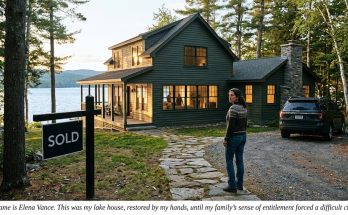
Three years after the sale, I received another photograph from James.
By then, I had almost forgotten how often he used to send them.
This one was different.
The lake house stood beneath a summer sky.
The porch had been repainted.
The gardens had grown.
The dock looked stronger than ever.
And beside the fireplace, visible through the open windows, was the brass plaque bearing my grandfather's name.
James had written only one sentence.
I thought you might want to see what your grandfather's place looks like now.
I studied the photograph for a long time.
Then I smiled.
The house looked happy.
Not because buildings can be happy.
Because it looked cared for.
That was enough.
I placed the photograph beside Grandpa's old fishing picture.
My mother was sitting across from me.
She had come for coffee.
She looked at the image.
“That's beautiful.”
“It is.”
“You don't miss it?”
I considered the question.
“I miss Grandpa.”
She nodded.
“But not the house?”
“Not the way I used to.”
She smiled.
“I think I finally understand.”
“What?”
“You didn't sell the house because you stopped loving it.”
“No.”
“You sold it because you realized loving something doesn't mean keeping it forever.”
I looked at her.
“Yes.”
She reached for her coffee.
“That took us all a long time to learn.”
“It did.”
Our relationship was never exactly what it had been before the lake house.
I don't think it could have been.
Some innocence had disappeared.
But something more honest had replaced it.
My mother no longer assumed access.
I no longer assumed silence was kindness.
Megan no longer treated family expectations as automatic obligations.
Richard became the quiet mediator he had always wanted to be, although we occasionally reminded him that sometimes mediation was just another way of avoiding uncomfortable truths.
We laughed more.
That surprised me.
I had once thought the conflict would permanently poison every family gathering.
Instead, time and accountability changed the atmosphere.
Not completely.
But enough.
My mother continued therapy.
She told me that once, during a session, she had been asked what she believed she had lost when Grandpa died.
She said, “A place.”
The therapist asked, “Was it the place?”
My mother eventually realized the answer was no.
She had lost her father.
The house had simply become the object she could point to.
Something physical.
Something she could try to preserve.
Grief had made her afraid.
Fear had made her controlling.
Control had made her dishonest.
And dishonesty had nearly destroyed the family she had been trying to preserve.
She told me this one evening while we sat on the porch.
“I wish I had understood that sooner.”
“So do I.”
“But I didn't.”
“No.”
She looked toward the trees.
“Do you forgive me?”
The question was quiet.
I didn't answer immediately.
I wanted to be honest.
“Yes,” I said finally.
Her eyes filled.
“But forgiveness doesn't mean I forget.”
“I know.”
“And it doesn't mean everything goes back to how it was.”
“I know.”
“It means I don't want to carry the anger anymore.”
She nodded.
“That is enough.”
I think it was enough for both of us.
Later that summer, Megan brought her children to the cabin.
They had grown considerably.
The oldest was almost a teenager.
He asked me whether the lake house was bigger.
“Yes.”
“Did you like it better?”
I thought about it.
“I loved it.”
“That wasn't what I asked.”
I laughed.
“No.”
He looked confused.
“Why?”
“Because this place is mine.”
He looked around.
“But the other one was yours too.”
“Yes.”
“Then why was this one better?”
I pointed toward the porch.
“Because nobody else gets to decide what it means.”
He nodded as though that made perfect sense.
Children sometimes understand boundaries better than adults.
That evening, we cooked dinner outside.
There was smoke in the air.
Someone burned the first batch of corn.
Everyone laughed.
My mother sat at the table.
Megan's children argued over dessert.
Richard told the same story he had told for years.
This time, nobody cared that we had heard it before.
I looked around.
The family was still here.
Not the same family.
A better-defined one.
There were rules now.
People asked.
People listened.
People accepted no.
It wasn't perfect.
But it was real.
After everyone left, I washed the dishes alone.
The cabin was quiet again.
I stepped outside.
The stars were bright.
I thought about the night I had driven away from the lake house after my mother told me I wasn't welcome.
I remembered how angry I had been.
How humiliated.
How convinced I had lost something.
Now, years later, I saw that night differently.
It had not been the night I lost my home.
It had been the night I realized I had never been protecting my home properly.
I had protected the building.
I had protected the memories.
I had protected everyone else's feelings.
I had forgotten to protect myself.
The decision to sell had changed everything.
But the sale itself wasn't the most important thing.
The important thing was that I had finally accepted responsibility for my own choices.
I had chosen to sell.
I had chosen not to fight endlessly.
I had chosen to let my mother face the consequences of her actions.
I had chosen to forgive without surrendering my boundaries.
I had chosen to keep loving my family without allowing love to become ownership.
That was what Grandpa had given me.
Not a lake house.
A choice.
Months later, James called.
His voice sounded excited.
“I wanted to tell you something.”
“What?”
“We're opening the house to family again.”
I smiled.
“That's nice.”
“But we're doing something different.”
“What?”
“We're putting a little plaque near the entrance.”
“What kind?”
He laughed.
“House rules.”
I could hear paper rustling.
“Number one: Ask before using anything.”
I laughed.
“Good.”
“Number two: Respect the property.”
“Excellent.”
“Number three: Leave the place better than you found it.”
I smiled.
“And number four?”
He paused.
“Remember that nobody owns a memory.”
I became quiet.
“That one's good.”
“I thought you'd like it.”
I thanked him.
After the call, I went outside.
The sunset spread across the hills.
I thought about Grandpa.
About the note.
About the fireplace.
About the lake.
About my mother.
About the forged document that had nearly destroyed us.
I wondered whether I would have done anything differently.
Maybe I would have set boundaries sooner.
Maybe I would have listened to my own discomfort.
Maybe I would have asked harder questions.
But I couldn't rewrite the past.
And I no longer wanted to.
Every mistake had taught me something.
Every painful conversation had forced honesty.
Every boundary had changed the shape of my relationships.
Even the sale had become part of the family's story.
Not the story my mother wanted.
Not the story I wanted.
Just the truth.
The house had once been my grandfather's.
Then it became mine.
Then it belonged to someone else.
And somehow, through all those changes, what mattered most survived.
His memory survived.
My family survived.
I survived.
Years later, I still kept the original letter in a wooden box beside my bed.
The paper had become soft around the edges from being handled so often.
Sometimes I read it.
Not because I need reassurance anymore.
Because I like hearing his voice in the words.
If one day you decide to sell it, sell it without guilt.
He had given me permission before I ever needed it.
I just hadn't understood what that permission meant.
It wasn't permission to abandon something.
It was permission to choose.
That was the gift.
One evening, I opened the box again.
The fishing photograph was there.
So was my mother's apology.
So was James's photograph of the lake house.
Three pieces of paper.
Three different chapters.
I placed them side by side.
The past.
The wound.
The peace.
Then I closed the box.
Outside, the wind moved through the trees.
I could hear the old cabin settling around me.
I smiled.
There had been a time when I thought a home was a place that other people could take from you.
Now I knew better.
A home was not a deed.
It wasn't a lake.
It wasn't a fireplace.
It wasn't even the walls surrounding you.
A home was the place where you could make choices without being afraid that someone else's disappointment would make you unworthy of belonging.
My mother had once stood in the doorway of my grandfather's house and told me I wasn't welcome.
For years, those words had followed me.
They no longer did.
Because I had finally learned something she couldn't take away.
I didn't need anyone's permission to belong.
Not to a house.
Not to a family.
Not to my own life.
And when I turned off the light that night, I understood why Grandpa had trusted me with the lake house in the first place.
He wasn't trusting me to keep it.
He was trusting me to know when it was time to let it go.
I had finally done exactly that.
The End
Read more original stories on Feel Every Story.
My Mother Closed the Door on Me at the House I Had Spent Years Saving, and That One Sentence Changed What I Was Willing to Tolerate
Part 8 of 8